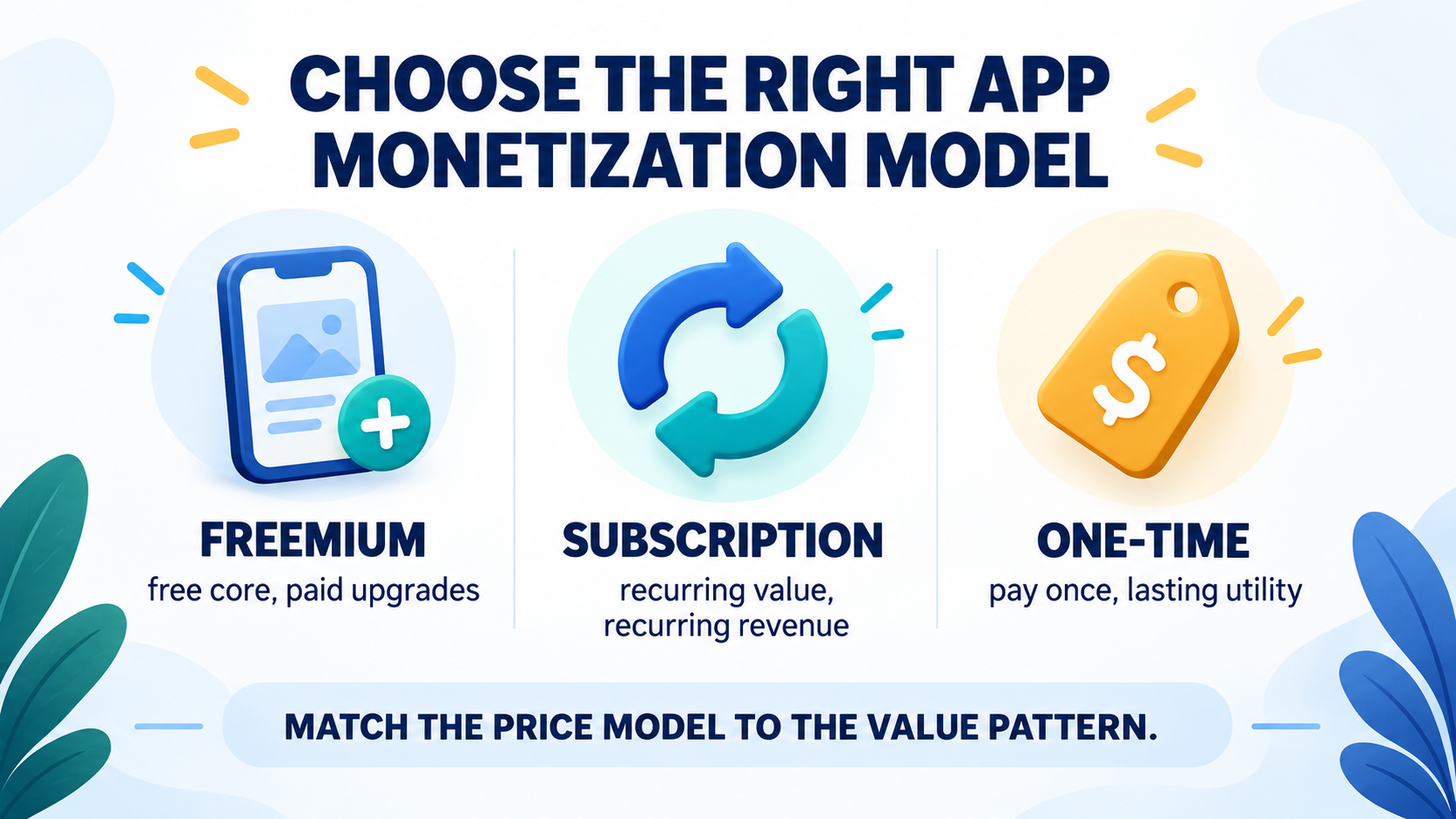
The question is not “Which model makes the most money?” in isolation. The useful question is: which model fits the way this product creates value, the costs it carries, and the trust users need before paying? A model can produce a strong first-month conversion rate and still fail if subscribers leave quickly, refunds rise, or the free tier costs more to serve than the business can support.
This guide gives you a practical way to choose. It covers the three common models, how to decide what belongs behind a paywall, how to model margin, and which signals tell you that the model is working. For the post-install side of the same product journey, see the guide to mobile app activation metrics.
Match the charge to the value pattern
Use freemium when users can experience a useful core before upgrading. Use a subscription when the app provides ongoing service, content, automation, or support. Use a one-time purchase when the product delivers durable utility and the ongoing cost per user is low. If the answer is mixed, start with the smallest model that fits the evidence and review it after real usage.
What each mobile app monetization model promises
The model changes more than revenue collection. It changes onboarding, support, product packaging, entitlement logic, retention expectations, and what users consider fair. Make the promise explicit before implementing a paywall.
| Model | Usually fits | Weak fit | Main risk |
|---|---|---|---|
| Freemium | A product with a useful free core and a natural upgrade based on capacity, convenience, depth, or automation. | An app where every free user creates significant recurring infrastructure or support cost. | A large free population with too little reason to pay, or a free experience that feels intentionally broken. |
| Subscription | Recurring content, collaboration, cloud service, monitoring, automation, or frequently updated capabilities. | A utility users buy once and rarely revisit, unless ongoing costs or updates are substantial and clearly explained. | Churn, renewal surprise, weak continuing value, and distrust around cancellation. |
| One-time purchase | Durable tools, offline utilities, focused creative functions, or products with limited ongoing service cost. | A service that pays continuing hosting, content, support, or data costs for every active user. | Revenue arrives once while maintenance and support continue for years. |
Freemium: make the free boundary useful
Freemium works when the free version lets a user reach a meaningful outcome and the paid version improves the scale, speed, depth, or repeatability of that outcome. The free experience is not merely a sample screen. It is the proof that the product can help.
Good boundaries are usually based on scope, scale, or automation. A free user might complete a limited number of projects, use a smaller history window, or access the core workflow without advanced automation. The boundary should be easy to explain in one sentence and should not invalidate work the user has already created.
A weak freemium boundary hides the basic result, interrupts the first useful action, or adds arbitrary friction that does not correspond to a real product cost. That may increase a short-term click rate while reducing trust. Explain what remains available, what the upgrade adds, and what happens to the user's data if they do not upgrade.
Subscription: earn the renewal, not just the first payment
A subscription is justified by continuing value. That value may come from fresh content, cloud storage, collaboration, monitoring, automation, support, or a product that gets materially better through ongoing service. If the user can receive the complete benefit in one session and has no reason to return, a recurring charge needs stronger justification.
Design the subscription around a repeatable job. What will the user come back to do next week or next month? What changes while they are away? What would disappear or become stale without the service? These answers should shape both the product roadmap and the paywall copy.
Be explicit about price, billing cadence, renewal, cancellation, and restoration. Apple documents subscription and in-app purchase requirements in its App Store Review Guidelines and subscription resources. Google documents the implementation side in its Google Play Billing overview and subscription guidance. Treat store requirements as part of the product design, not a final submission task.
One-time purchase: price the durable utility
A one-time purchase is easiest to defend when the app delivers a durable capability that does not require a large continuing service bill. It can be a good fit for a focused utility, an offline tool, or a product where major updates are occasional rather than continuous.
Do not confuse “one-time” with “no future work.” Users may expect bug fixes, compatibility updates, data portability, and reasonable support after purchase. Estimate the support and maintenance horizon before setting a lifetime price. If the app later adds a costly hosted service, make that change legible rather than silently converting the original promise.
Some products use a hybrid: a one-time unlock for the durable app and a subscription for an optional service with continuing costs. That can be fair when the boundary is clear. It becomes confusing when users cannot tell which part they bought or why a new recurring charge is necessary.
Ask three questions before choosing
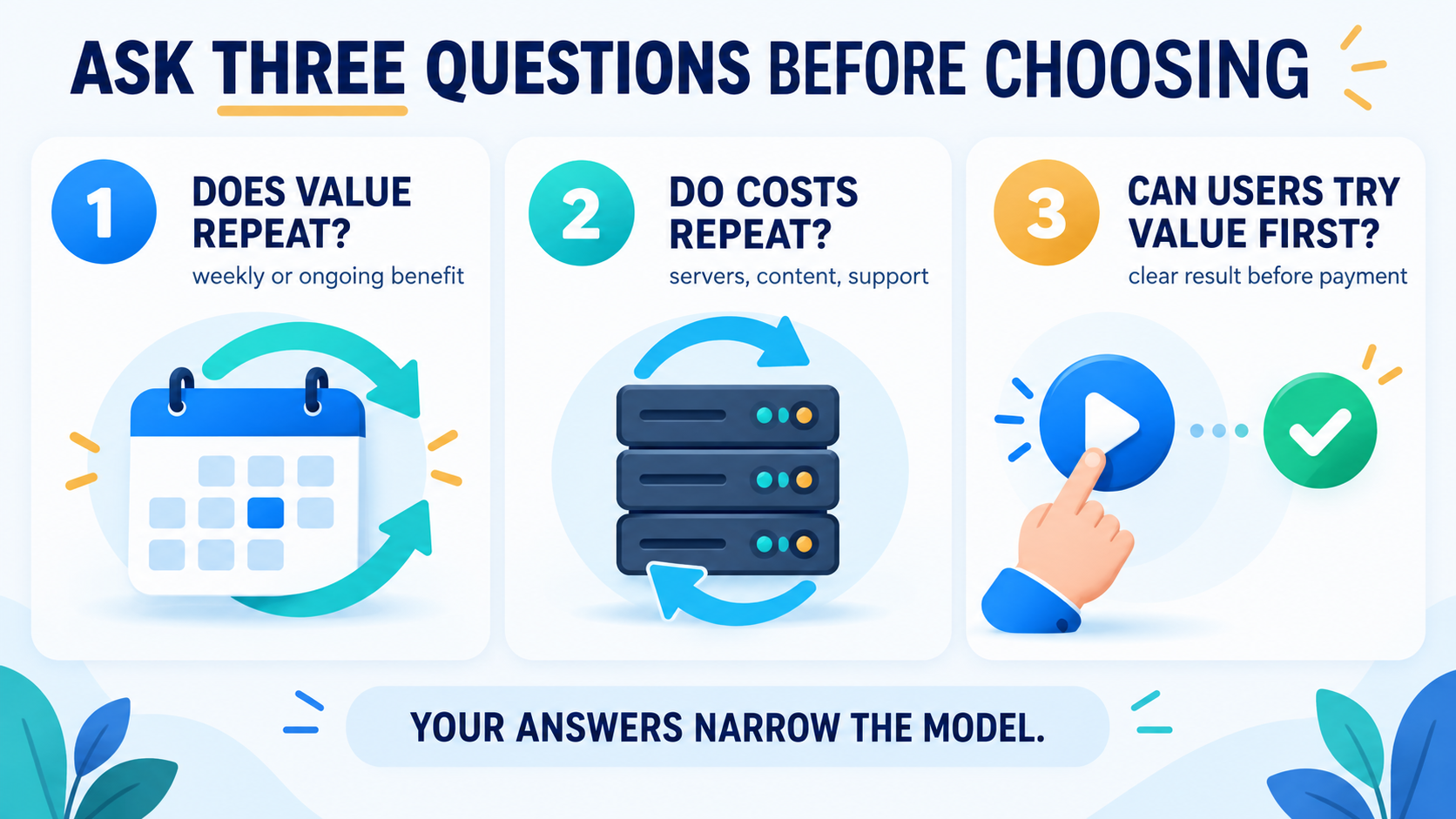
- Does the value repeat?Identify the job users return to perform and how often the result changes. Repeated value supports a recurring model more than a single-use outcome does.
- Do the costs repeat?List hosting, storage, content, data, support, moderation, and third-party costs that grow with active usage. A recurring cost needs a sustainable funding path.
- Can users try the value first?Find the smallest useful outcome a new user can reach before payment. If the product needs a trial, connect its length to time to that first meaningful result.
- Can the promise be explained simply?Write one sentence describing what free users get, what paid users gain, and why the charge is recurring or one-time. Confusion is a product problem before it is a pricing problem.
Design the paid boundary around value
There is no universal list of features that must be free or paid. Instead, choose a boundary that lets a new user understand the product and gives an active user a credible reason to upgrade. Useful boundaries include:
- Capacity: more projects, history, exports, team members, or tracked items.
- Depth: advanced analysis, customization, integrations, or controls for expert users.
- Automation: scheduled work, alerts, recurring reports, or background processing.
- Service: collaboration, hosted storage, support, synchronization, or fresh content.
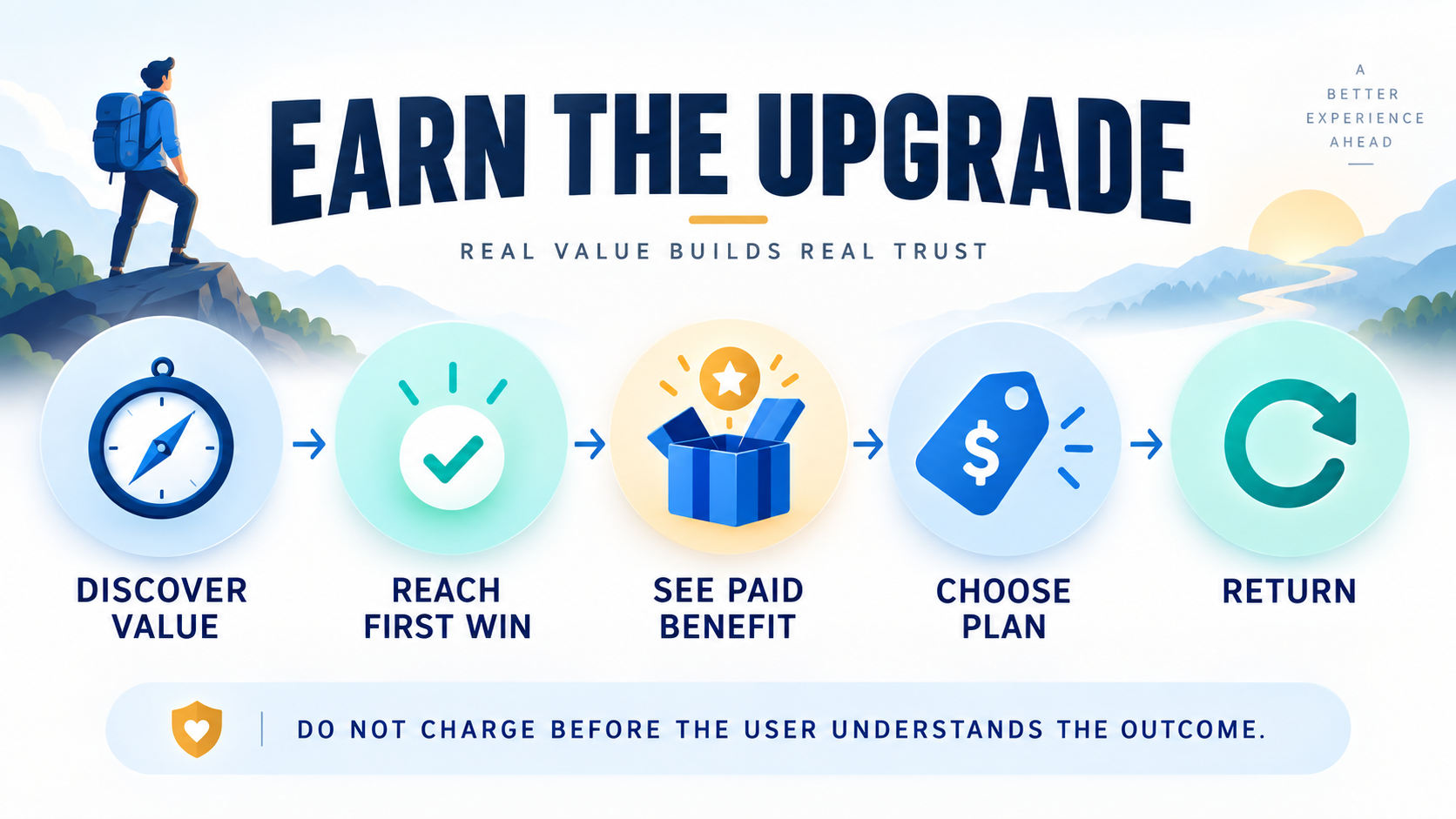
Keep the first successful outcome outside the paywall when possible. If payment must happen early because serving the action is expensive, show the user what the action will produce and why the cost exists. Never make users guess whether their work will be retained after a trial or downgrade.
Model unit economics before optimizing conversion
Conversion rate is only one part of monetization. Start with a simple contribution view:
Contribution margin per payer
Net revenue per payer - variable service cost - payment and support cost
Estimate this across a quiet month, an expected month, and a growth month. Include the service usage created by free users too. A plan that looks profitable at low usage can become unworkable when storage, processing, support, or content costs grow faster than retained revenue.
Keep platform fees and tax treatment in the model using the rules that apply to your product and market. Do not hard-code a permanent percentage into a general pricing article or spreadsheet; store terms and policies change. The important habit is to calculate from the money you actually keep, then subtract the costs caused by serving the customer.
Also model refunds, failed payments, discounts, trial abuse, support time, and the cost of users who remain free. If you cannot explain the assumptions behind the margin, the pricing decision is not ready for a conversion experiment.
Measure the whole loop
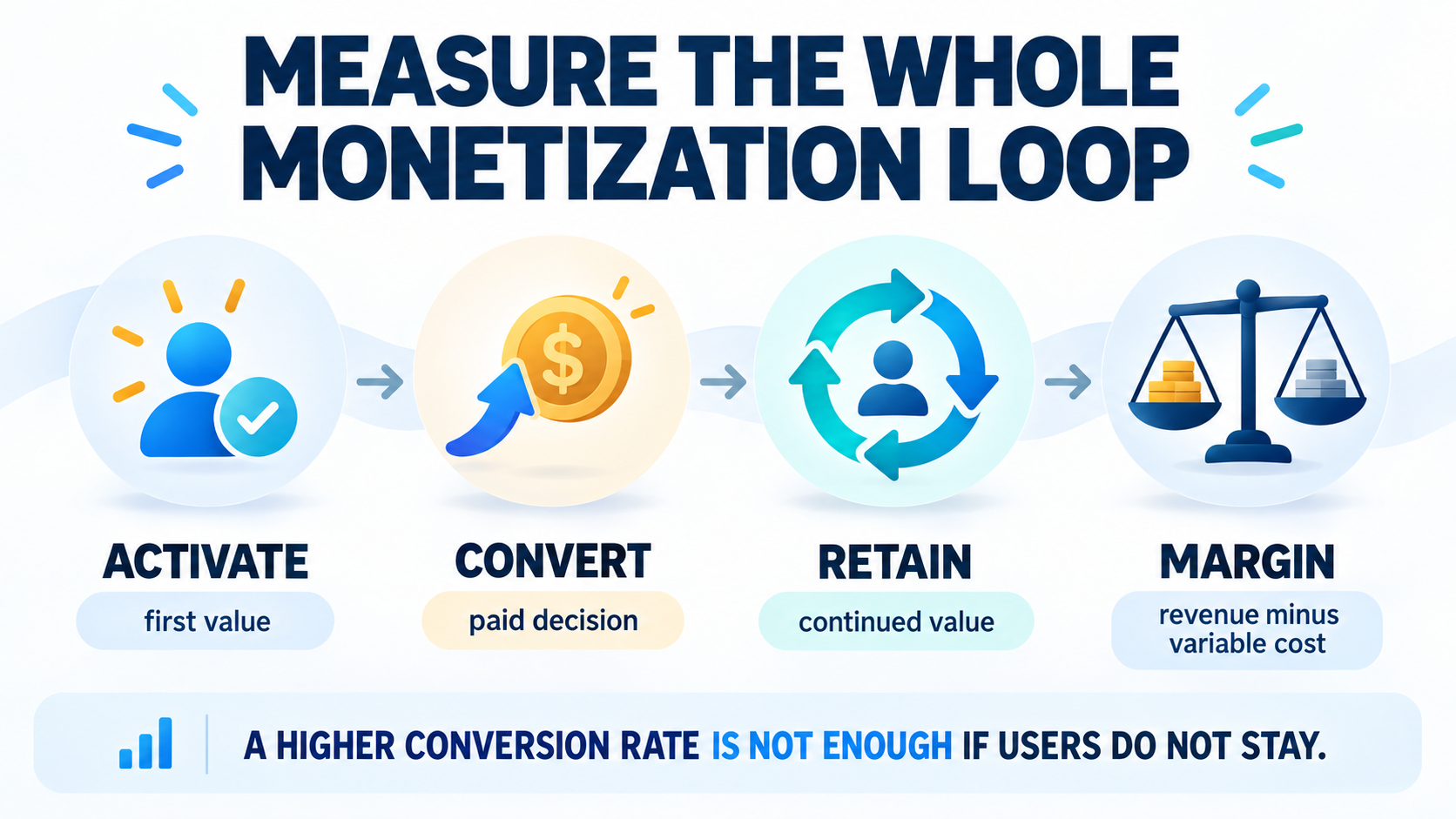
Use a sequence of metrics rather than a single “conversion” number. A useful minimum set is:
- Activation: the percentage of new users who reach the first meaningful outcome.
- Paywall engagement: who sees the offer, understands it, and starts a trial or checkout.
- Paid conversion: users who complete payment, separated by acquisition source and plan.
- Paid retention: whether customers remain after the first renewal or expected repeat-use period.
- Churn, refunds, and cancellations: the negative signals that explain whether the promise is sustainable.
- Realized revenue and margin: what remains after discounts, payment costs, service cost, and support.
Instrument the events with clear definitions. The Firebase Analytics events guide explains how to build a useful event taxonomy; use the same discipline for pricing events. Name the moment precisely: “paywall viewed,” “trial started,” “subscription renewed,” and “feature used” answer different questions. Avoid counting a button tap as revenue.
Use acquisition evidence without confusing it with revenue evidence
Pricing can be correct while acquisition is weak, or acquisition can be strong while the paywall fails. Keep the evidence separate so you know which part of the funnel needs attention. Store impressions and keyword visibility describe discoverability; activation, conversion, retention, and margin describe product economics.
If app-store discovery is part of your acquisition plan, Rank Analyzer Pro tracks keyword visibility by store and country. It helps you inspect the visibility side of the funnel; it does not replace product analytics or tell you why a user paid. Connect the two datasets only when their definitions and time windows are clear.
When a pricing model is not working
Look for patterns instead of reacting to one week of data:
- High usage, low conversion: users may value the free experience but not the paid boundary, or they may not understand the upgrade.
- High conversion, low retention: the paywall may promise more continuing value than the product delivers.
- High trial starts, high refunds: timing, price clarity, renewal expectations, or onboarding may be creating a trust gap.
- Healthy revenue, weak margin: service cost, support, discounts, or free usage may be too high for the current plan.
- One-time buyers keep asking for ongoing service: the product promise may have changed and needs a clearer split between durable utility and hosted value.
Each pattern points to a different intervention. Improve onboarding before changing price when users never reach value. Clarify the paid boundary when users use the app but do not understand the upgrade. Rework the model when the underlying value and cost pattern have changed.
A seven-day pricing review
- Day 1: write the promise.Describe the free outcome, paid outcome, billing cadence, and what happens after cancellation or downgrade.
- Day 2: map the value path.Mark discovery, activation, first paid benefit, renewal or repeat use, and the points where users hesitate.
- Day 3: list variable costs.Include free and paid usage, storage, content, support, third-party services, and payment-related costs.
- Day 4: audit the paywall.Check price, currency, cadence, renewal, restore, cancellation, entitlement state, and error messages on both stores.
- Day 5: inspect cohorts.Compare activation, conversion, retention, refunds, and margin by acquisition source and plan rather than using one blended average.
- Day 6: choose one test.Change one meaningful variable such as the free boundary, explanation, trial timing, or plan packaging.
- Day 7: record the decision.Write the hypothesis, success metric, guardrail metric, test window, and the evidence that would make you stop or continue.
FAQ
Which monetization model is best for a mobile app?
The best model matches how the app creates value. Freemium fits products that can demonstrate useful value before an upgrade. Subscriptions fit recurring service, content, or workflow value. One-time purchases fit durable utility with limited ongoing cost. Validate the choice with retention, conversion, support load, and margin rather than copying a competitor.
Is freemium a good model for a small app?
Freemium can work for a small app when the free experience is useful, the paid boundary is clear, and the cost of serving free users is manageable. It is risky when every free user creates high variable cost or when the free version is too limited to demonstrate the product's value.
Should a mobile app offer a free trial?
Offer a trial when users need time to experience recurring value and you can explain its length, price, renewal, and cancellation clearly. Set the trial around time to first meaningful outcome, then measure activation, trial conversion, paid retention, cancellations, and refunds.
When should an app change its monetization model?
Consider a change when user behavior, ongoing costs, retention, or product value no longer match the current model. Look for evidence such as strong usage but weak conversion, high conversion but poor retention, support costs that exceed contribution margin, or a product that has shifted from a durable utility to an ongoing service.
Conclusion
Freemium, subscription, and one-time purchase can all work. The durable choice is the one that makes a fair promise, funds the costs of delivering it, and gives users a reason to keep using the product. Start from the value pattern, make the paid boundary understandable, and measure retention and margin alongside conversion.
Pricing is not finished when the checkout works. Review the promise when the product adds a hosted service, when costs change, or when the user journey changes. For related product measurement, continue with mobile app activation metrics and Firebase Analytics event planning.