
The goal of app keyword research is not to build the longest possible list. It is to create a small, explainable set of terms that connect product meaning with how people search. That requires several stages: understand the app, build different intent groups, use competitor language carefully, evaluate multiple signals, verify current visibility, and turn the pool into a shortlist.
Build five keyword groups
One seed phrase rarely captures an entire product. Separating ideas into five groups helps avoid a list dominated by category head terms. Consider a generic habit-planning app that helps people build routines, maintain streaks, and remember daily actions. Its keyword map should describe more than “productivity.”
1. Category keywords
Category terms describe what the product broadly is: habit tracker, routine planner, goal tracker, or productivity planner. They orient the research but often carry mixed intent and strong competition. Use them as anchors, not as the whole strategy.
2. Feature keywords
Feature terms describe concrete capabilities such as streak calendar, habit reminders, progress chart, recurring checklist, or routine notifications. They are valuable when the capability is central enough that a user searching for it would be satisfied by the app.
3. Audience keywords
Audience terms connect the product to a group with a recognizable need: habit planner for students, routine app for busy adults, or simple tracker for beginners. The audience must be real and product-supported; adding demographic language without a meaningful experience creates weak relevance.
4. Problem keywords
Problem terms describe the friction a person wants to remove, such as stop forgetting habits, stay consistent, build a morning routine, or remember daily goals. Natural problem language can reveal intent that feature-only research misses.
5. Long-tail and use-case keywords
Long-tail phrases combine several signals: morning routine checklist, daily habit streak tracker, simple goal reminder app, or weekly habit progress calendar. Longer is not automatically better, but a natural phrase that accurately captures a use case can be easier to interpret and act on.
App keyword examples across categories
The same five-group framework works across app types. Keep the examples illustrative: only shortlist a term when the app actually supports the promised experience and the selected country uses the phrase naturally.
| Keyword type | Example | Good for | Risk |
|---|---|---|---|
| Game app — long-tail | offline puzzle game | Matching a specific play style and feature | Weak fit if offline play is not supported |
| AI chat app — feature | AI writing assistant | Reaching users looking for a clear capability | Broad AI terms can hide mixed intent |
| Fitness app — use case | home workout planner | Connecting the product to a concrete routine | Do not target it if planning is not a core feature |
| Finance app — problem | budget tracker app | Capturing users trying to manage spending | Finance terms can create trust and compliance expectations |
| Bible/devotional app — audience | daily Bible devotional | Reaching users seeking a repeat reading habit | Country and denomination language may differ |
| Productivity app — feature | focus timer | Testing a recognizable productivity capability | High relevance is not guaranteed by a common feature name |
Create a candidate map from the five groups
| Group | Example terms | User intent | Potential role |
|---|---|---|---|
| Category | habit tracker, routine planner | Find a general product type | Broad market benchmark |
| Feature | streak calendar, habit reminders | Find a specific capability | Feature-led tracking |
| Audience | habit planner for students | Find a product for a defined user | Audience-positioning test |
| Problem | stop forgetting habits | Solve a recurring frustration | Problem-intent research |
| Long-tail | morning routine checklist | Complete a specific use case | Focused test or tracked term |

Use competitor language without copying blindly
Direct competitors can reveal repeated vocabulary that users and the category already recognize. Look for category words that appear across several relevant listings, feature language used by products with similar capabilities, and audience or problem phrases that match your app. Repetition across direct alternatives is more meaningful than one isolated term from a distant category leader.
Competitor research also produces noise. A competitor-only phrase may describe a feature your app does not have, a different audience, a regional use case, or a business model mismatch. Brand tokens should remain excluded from generic discovery, and a high-ranking giant should not become the standard for every decision. The competitor app keyword tracker framework explains how to separate direct alternatives, adjacent products, and broad category leaders.
Evaluate each candidate with multiple signals
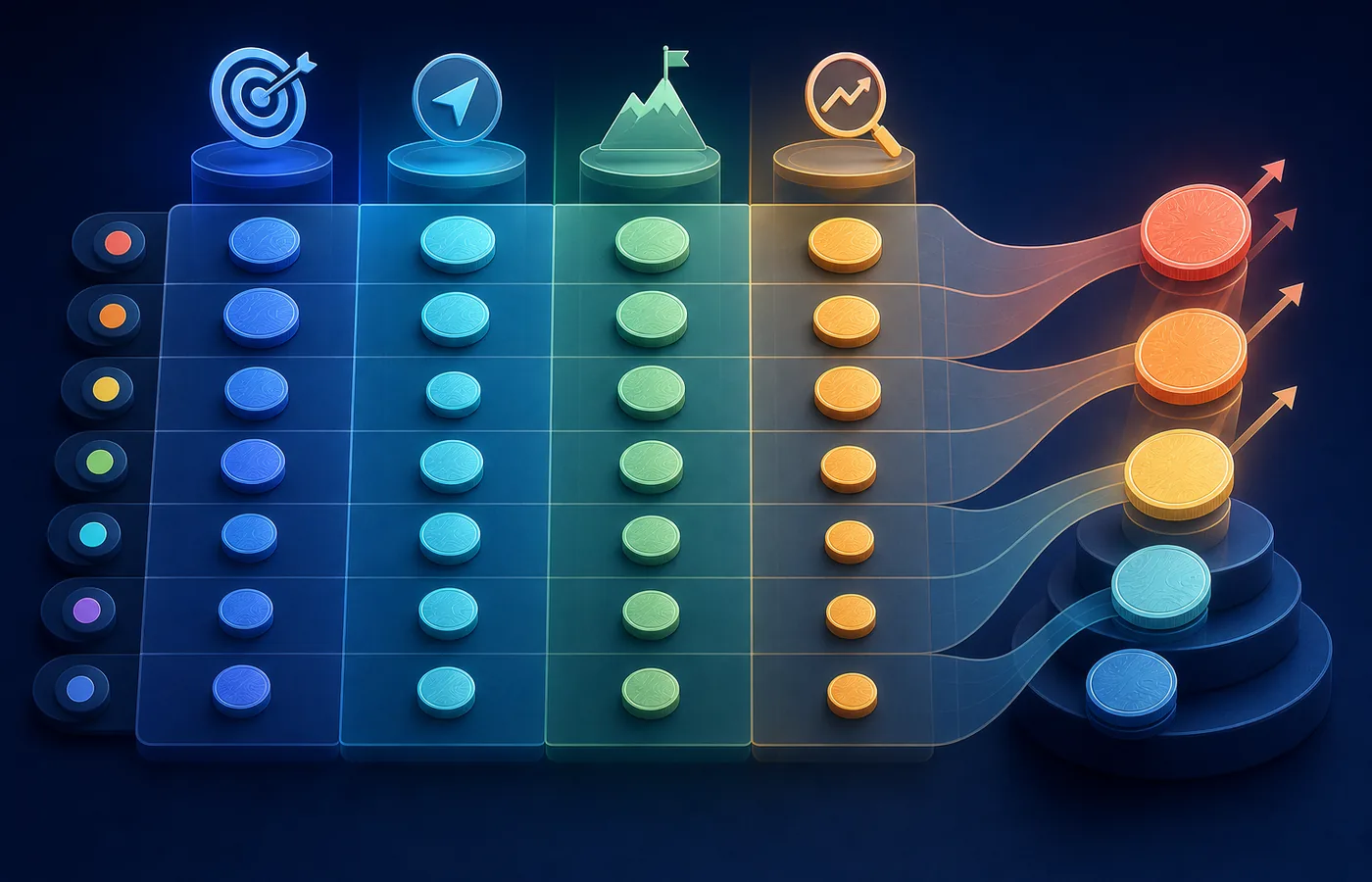
No single metric can decide whether a keyword is useful. Relevance asks whether the app can satisfy the query. Estimated demand indicates directional interest, not exact traffic. Difficulty is comparative, not a guaranteed probability. Current rank is evidence of present visibility, not a promise of future performance. Competitor coverage shows how often relevant rivals appear. Country fit checks whether the phrase and opportunity make sense in the selected market. Business importance asks whether movement would change a product or acquisition decision.
Human judgment is essential. A term can score well numerically and still misrepresent the product. Another can have modest demand but describe a high-value feature and a clear user need. Treat every score as a structured discussion aid rather than scientific certainty.
| Keyword | Relevance | Demand | Difficulty | Current evidence | Decision |
|---|---|---|---|---|---|
| habit planner | High | High | High | Observed at #18 | Track now |
| morning routine checklist | High | Medium | Medium | Not observed | Test first |
| streak calendar | High | Medium | Medium | Direct rivals visible | Verify, then track |
| productivity | Medium | High | High | Weak specificity | Low priority |
| team project board | Low | Medium | High | Product mismatch | Discard |
Verify keywords before relying on them
Discovery creates possibilities; verification checks a specific claim. Confirm the correct store, country, app listing, keyword spelling, and tracked search depth. Record the current observed position and timestamp. If the app is not observed, describe the result precisely: “not observed inside the tracked depth” is not the same as “the app has no visibility anywhere.”
Verification also prevents country and store context from disappearing. An App Store result in the United States cannot be substituted for a Google Play result in India, and a rank for the wrong listing is not useful evidence. The app keyword tracking tool connects current checks with a selected monitoring list while preserving those dimensions.
Verify where your app ranks for candidate keywords right now
Don't guess which keywords have real traction. Run an instant live rank check across 150+ App Store & Google Play storefronts with exact search depth.
Turn candidates into a practical shortlist
Every candidate should end in one of three decision paths. This keeps the monitoring list focused and makes uncertainty visible.
Track now
Use for highly relevant terms with meaningful current visibility, strategic importance, and a clear reason to monitor movement.
Test first
Use for strongly relevant terms with no current observed rank, uncertain demand, or unclear competitive feasibility. Verify and collect evidence before treating them as core.
Discard
Use for weak relevance, brand mismatch, poor user-intent fit, or broad terms that do not support a practical product or metadata decision.
ASO keyword shortlist template
Give every shortlisted term enough context that another teammate can understand the decision without repeating the research. The fields below keep product evidence attached to the keyword.
| Keyword | Store | Country | Intent | Current rank | Competitor visibility | Priority | Decision |
|---|---|---|---|---|---|---|---|
| focus timer | App Store | United States | Feature | #24 | 3 direct rivals visible | High | Track |
| home workout planner | Google Play | United Kingdom | Use case | Not observed | 2 direct rivals visible | Medium | Test |

Refresh the shortlist when the product or market changes
Keyword research is not a one-time export. Revisit the groups after a meaningful feature launch, positioning change, localization update, new country rollout, or shift in the direct competitor set. Preserve the previous shortlist so the team can see which terms were added, retired, or reclassified and why. Do not rebuild the entire list after every daily fluctuation.
A useful review asks whether each tracked term still represents an important category, feature, audience, problem, defensive position, or controlled opportunity. Retire terms that repeatedly fail the relevance test. Replace them with candidates supported by new product context or repeated market language. This keeps tracking capacity focused and makes future ranking movement easier to interpret.
Keep a brief decision record with the shortlist: why each term was selected, which market it belongs to, what would count as useful progress, and when it will be reviewed. That record turns discovery into a repeatable research process and prevents the next refresh from starting from zero.
Document rejected terms too, especially brand leakage and product mismatches, so they do not return during the next candidate-generation cycle.
Common app keyword research mistakes
Choosing volume over relevance
Directional demand cannot rescue a term that does not describe the product or match user intent.
Using only one broad seed
A single category word hides feature, audience, problem, and use-case language.
Copying competitors
Competitor vocabulary is evidence to evaluate, not metadata to duplicate.
Mixing stores and countries
A candidate and its ranking evidence belong to a specific market context.
Treating suggestions as verified ranks
Suggested relevance and current observed visibility are different claims.
Tracking too many terms
An oversized list consumes attention and makes meaningful movement harder to see.
Ignoring long-tail intent
Specific natural phrases can reveal clearer jobs and problems than broad category terms.
Changing metadata without a baseline
Without pre-change observations, post-change movement is harder to interpret.
Keywords to avoid
A keyword can look attractive in a suggestion list and still be a poor ASO choice. Exclude terms that create a promise the app cannot keep or that mix incompatible markets and intent.
- Competitor brand names that do not describe your own app.
- Very broad category terms with no clear product or user-intent fit.
- Unrelated high-volume phrases chosen only because they look popular.
- Phrases unsupported by the app's features, content, or user experience.
- Country or language mismatches that do not reflect the selected storefront.
Move from research to tracking
Once the shortlist is stable, establish a baseline for important terms, preserve the stores and countries that matter, and compare direct competitors on the same market. Review movement after metadata or product changes, but avoid claiming the change caused the outcome solely because the dates overlap. Historical tracking is most useful when it records both observations and decisions.
The broader ASO rank tracker shows how current checks, market-specific history, and competitor context fit into a weekly review. If visibility declines, use the guide to diagnose an app keyword ranking drop before replacing relevant terms.
FAQ
How do I find keywords for my app?
Start with the app category, core job, target audience, problem solved, and natural user phrases. Build category, feature, audience, problem, and long-tail groups before using competitor language and ranking evidence to refine the list.
What makes an app keyword high potential?
A high-potential keyword closely matches the product and user intent, has enough evidence to justify a test or tracking, fits the selected country, and is tied to a practical action.
Should I target high-volume keywords?
Estimated demand is useful but directional. A high-volume term with weak relevance or unrealistic competition can be less valuable than a specific phrase with stronger intent and actionability.
How many app keywords should I track?
Use the smallest set that adequately represents important categories, features, audiences, problems, and use cases. The exact number depends on your app and plan, but every tracked term should have a clear reason for inclusion.
Can competitor apps help with keyword research?
Yes. Direct competitors can reveal repeated category, feature, and audience vocabulary, but brand tokens and product mismatches should be excluded and every term should be checked against your own app.
Should I track keywords before changing metadata?
Tracking important terms before a metadata change creates a baseline. That history makes the post-change review more useful and reduces the risk of reacting to one isolated observation.
Build the smallest useful keyword list
A strong keyword list is not the longest list. It is the smallest useful set of relevant, evidence-backed terms tied to a clear action. Start with product meaning, widen the research through five intent groups, learn from direct competitors without copying them, verify current visibility, and keep only the terms that deserve a test or history.